Glossary
Terms
A
| hardening by aging, usually after rapid cooling or cold working | |
| a generic term denoting a treatment, consisting of heating to and holding at a suitable rate, used primarily to soften metallic materials, but also to simultaneously produce desired changes in other properties or microstructure. | |
| a heat treatment for ferrous alloys in which a part is quenched from the austenizing temperature at a rate fast enough to avoid formation ferrite or pearlite and then held at a temperature just above Ms until transformation to bainite is complete. | |
| a solid solution of one or more elements in face-centered cubic iron. unless otherwise designated, the solute is generally assumed to be carbon. | |
| forming austenite by heating a ferrous alloy into the transformation range or above the transformation range. when used without qualification, the term implies austenitizing. | |
B
| a metastable aggregate of ferrite and cementite resulting from the transformation of austenite at temperatures below the pearlite range but above Ms. Its appearance is feathery if formed in the upper part of the bainite transformation range; acicular, resembling tempered martensite, if formed in the lower part. | |
| brittleness exhibited by some steels after being heated to some temperature within the range of about 200 to 300 degree celcius, particularly if the steel is worked at the elevated temperature. Killed steels are virtually free of this kind of brittleness. | |
| annealing in a protective medium to prevent discoloration of the bright surface. | |
C
| a case hardening process in which a suitable ferrous material is heated above the lower transformation temperature in a gaseous atmosphere of such composition as to cause simultaneous absorption of carbon and nitrogen by the surface and, by diffusion, create a concentration gradient. The process is completed by cooling at a rate that produces the desired properties in the workplace. | |
| a measure of the ability of an environment containing active carbon to alter or maintain, under prescribed conditions, the carbon level of the steel. | |
| absorption and diffusion of carbon into solid ferrous alloys by heating, to a temperature usually above Ac3, in contact with a suitable carbonaceous material.A form of case hardening that produces a carbon gradient extending inward from the surface, enabling the surface layer to be hardened either by quenching directly form carburizing temperature or by cooling to room temperature, then reaustenitizing and quenching. | |
| a generic term covering several processes applicable to steel that chnge the chemical composition of the surface layer by absorption of carbon, nitrogen, or a mixture of the two and, by diffusion, create a concentration gradient. The processes commonly used are carburizing and quench hardening; cyaniding; nitriding; and carbon nitriding. | |
| exposing to suitable subzero temperatures for the purpose of obtaining desired conditions or properties such as dimensional or microstructural stability. When the treatment involves the transformation of retained autenite, it is usually followed by tempering. | |
| in a ferrous alloy prepared for case hardening, that portion of the alloy that is not part of the case. Typically considered to be the portion that: | |
| (a) appears light on an etched cross-section | ||
| (b) has an essentially unaltered chemical composition, or | ||
| (c) has a hardness, after hardening, less than a specified value. | ||
F
| a solid solution of one or more elements in a body-centered cubic iron. Unless otherwise designated, the solute is generally assumed to be carbon. On some equilibrium diagrams, there are two ferrite regions separated by an austenite area. The lower area is alpha ferrite; the upper, delta ferrite. If there is no designation, alpha ferrite is assumed. | |
| a process for hardening the surfaces of hardenable ferrous alloys in which an intense flame is used to heat the surface layers above the upper transformation temperature, whereupon the workpiece is immidiately quenched. | |
| an imprecise term that donates an annealing cycle to producde minimum strength and hardness. For the term to be meaningful, the composition and starting condition of the material and the time-temperature cycle used must be stated. | |

G
| for metals, a measure of the areas or volumes of grains in a polycrystalline material, usually expressed as an average when the individual sizes are fairly uniform. In metals containing 2 or more phases, the grain size refers to that of the matirx unless otherwise specified. Grain sizes reported in terms of number or grains per unit area or volume, average diameter, or as a grain-size number derived from area measurememts. | |
H
| increasing hardness by suitable treatment usually involving heating and cooling. | |

I
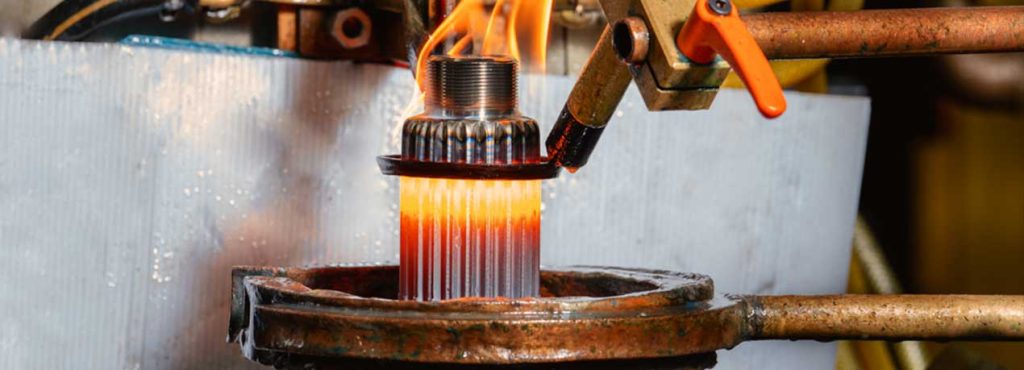
| a surface-hardening process in which only the surface layer of a suitable ferrous workpiece is heated by electromagnetic induction to above the upper critical temperature and immidiately quenched. | |
M
| a hardening process in which an austenitized ferrous workpiece is quenched into an appropriate medium whose temperature is maintained substantially at the Ms of the workpiece, held in the medium until its temperature is uniform throughout, but not long enough to permit bainite to form, and then cooled in air. | |
N
| any of several processes in which both nitrogen and carbon are absorbed into the surface layers of a ferrous material at temperatures below the lower critical temperature and, by diffusion, create a concentration gradient. Nitrocarburizing is done mainly to provide an antiscuffing surface layer and to improve fatigue resistance. | |
| heating a ferrous alloy to a suitable temperature above the transformation range and then cooling in air to a temperture substantially below the transformation range. | |
P
| a metastable lamellar aggregate of ferrite and cementit resulting from the transformation of austenite at temperatures above the bainite range. | |
| hardening caused by the precipitation of a constituent from a supersaturated solid solution. | |

Q
| fracture of a metal during quenching from elevated temperature. Most frequently observed in hardened carbon steel, alloy steel, or tool steel parts of high hardness and low toughness. Cracks often emanate from fillets, holes, corners, or other stress raisers and result from high stresses due to the volume changes accompanying transformation to martensite. | |
| (1) | hardening suitable alpha-beta alloys by solution treating and quenching to develop a martensitic-like structure. |
| (2) | in ferrous alloys, hardening by austenitizing and then cooling at a rate such that a substantial amount of austenite transforms into martensite. | |
S
| heating an alloy to a suitable temperature, holding at that temperature long enough to cause one or more constituents to enter into solid solution, and then cooling rapidly enough to hold these constituents in solution. | |
| heating and cooling to produce a spheroidal or globular form of carbide in steel. | |
| heating to a suitable temperature, holding long enough to reduce residual stress, and then cooling slowly enough to minimize the development of new residual stress. | |
| a process anneal performed on ferrous alloys at a temperature below Ac1. | |
T
| reheating hardened stell or hardened cast iron to some temperature below the eutectoid temperature for the purpose of decreasing hardness and increasing toughness. The process also is sometimes applied to nomalized steel. | |